Check the label on your prenatal vitamin, and your postnatal one. There is a reasonable chance choline is not on either.
Choline is a nutrient most people have never heard of. Most prenatal and postnatal vitamins either leave it out entirely or include far less than research suggests you need. That gap matters across pregnancy and breastfeeding, because the evidence for what choline does for fetal brain development, and for what passes through breast milk to your baby, is growing.
What choline actually does
Choline is an essential nutrient. Your body makes small amounts, but not enough to meet demand, particularly during pregnancy and breastfeeding. It plays a central role in building cell membranes, producing a neurotransmitter called acetylcholine (involved in memory and muscle function), and supporting the early development of the fetal brain and spinal cord.
It also works alongside folate in the development of the neural tube, the structure that becomes the brain and spine. That link is what first drew researchers' attention to it as a potential factor in neural tube defects (NTDs) that continue to occur even in countries with mandatory folic acid fortification.
The NTD connection
A 2009 study drew on blood samples from over 180,000 pregnancies in California (1). Of 13 nutrients measured, choline was the only one independently associated with NTD risk. Women with the lowest choline levels had roughly 2.4 times the NTD risk compared to women with average levels.
This is observational data. It cannot prove that choline supplementation prevents NTDs. But the finding is notable because these women were already living in a country with folic acid fortification, which suggests that folate alone may not be the whole picture, and that choline could be part of what fills the gap.
The brain development evidence
A randomised controlled trial at Cornell University assigned 26 pregnant women in their third trimester to either 480mg or 930mg of choline per day (2). Infants born to the higher-dose group showed faster information processing at 4, 7, 10, and 13 months. When the same children were followed up at age 7, those whose mothers had taken the higher dose showed better sustained attention and visuospatial memory, representing the first evidence from a randomised controlled trial that prenatal choline supplementation improves cognitive outcomes on behavioural tasks (3).
Twenty-six women. Twenty children assessed at age 7. These are preliminary findings, not settled science. But they are the best controlled evidence available, and the direction is consistent with what animal research has shown for decades.
How much is recommended, and who is setting it
The US National Academy of Medicine recommends 450mg of choline per day during pregnancy, rising to 550mg while breastfeeding. The European Food Safety Authority sets its figures at 480mg during pregnancy and 520mg during breastfeeding. Neither the NHS nor the UK's Scientific Advisory Committee on Nutrition has established an official recommendation for choline yet, which means there is currently no UK-specific target.
The increase during breastfeeding reflects how much choline is transferred into breast milk. Demand on the mother's stores does not drop once the baby arrives. If anything, it increases. Yet postnatal vitamins are even less likely to include choline than prenatal ones.
Most pregnant and breastfeeding women fall well short of even the lower end of those figures. A review of the top prenatal vitamins found that only around a third contained choline at all. Even those that do often include a fraction of what the research suggests is beneficial.
Food sources
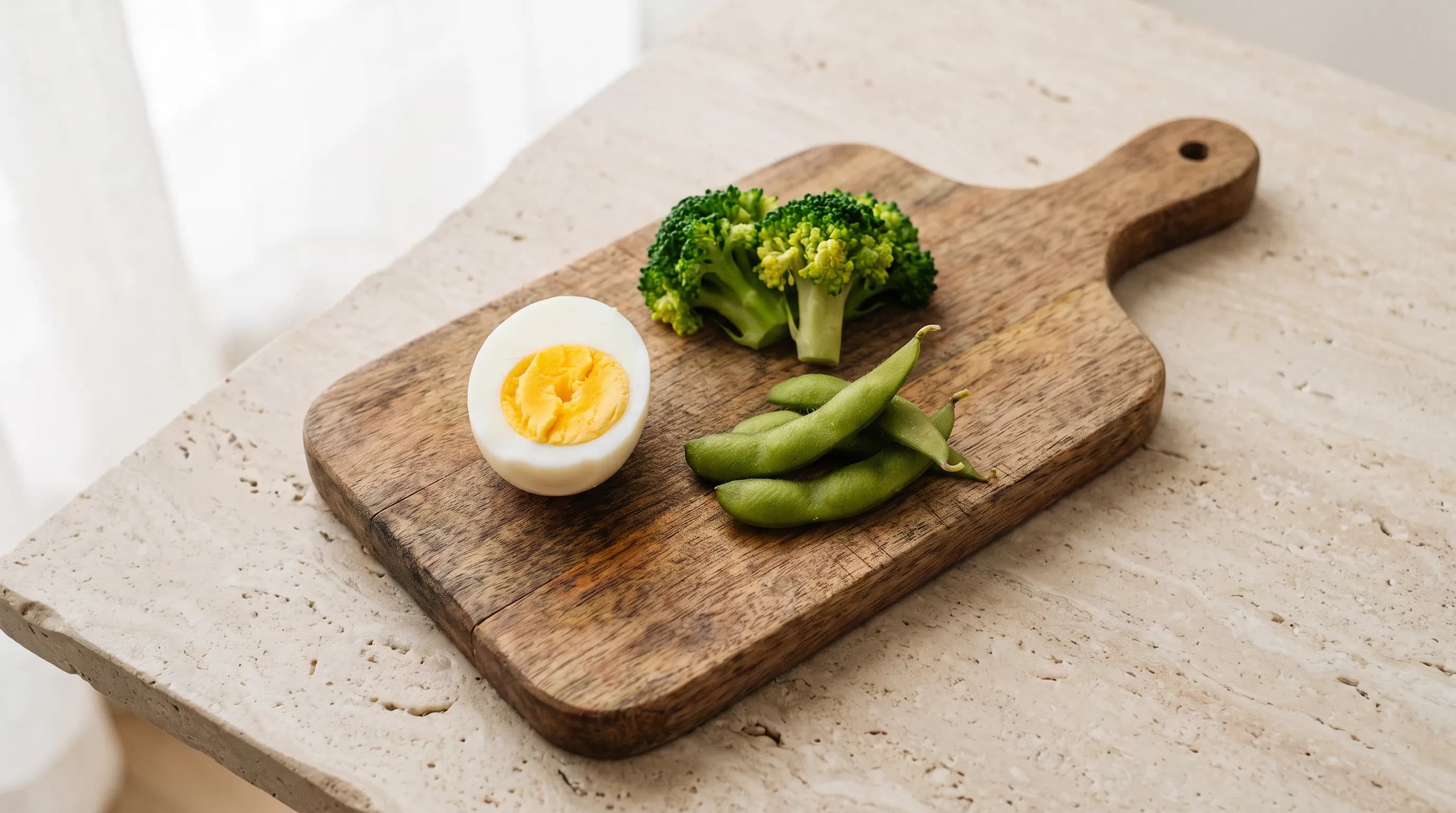
Eggs are the most practical source: one large egg contains roughly 147mg. Liver, meat, fish, and some plant sources such as soybeans and broccoli also contribute. Vegetarians and vegans are at particular risk of falling short, since the highest-choline foods are almost all animal-based.
The bottom line
Choline does not have the profile of folic acid, but the research base for its role in pregnancy and breastfeeding is building. Prenatal and postnatal supplements containing choline are available, and some combined prenatal vitamins now include it. It is worth checking your current label, and at what dose it appears. If you are considering adding a separate choline supplement, speak to your GP or midwife first.
On the nutrients that do have official UK guidance, including folic acid, our post on what folic acid actually does when you're trying to conceive is worth reading alongside this one.
Join our waitlist to be the first to try PregSafe.
PregSafe is not a replacement for medical advice. Always consult your healthcare provider for personalised guidance.
Sources
(1) Shaw GM, Carmichael SL, Yang W, Selvin S, Schaffer DM. Choline and risk of neural tube defects in a folate-fortified population. Epidemiology. 2009;20(5):714-719.
(2) Caudill MA, Strupp BJ, Muscalu L, Nevins JEH, Canfield RL. Maternal choline supplementation during the third trimester of pregnancy improves infant information processing speed: a randomized, double-blind, controlled feeding study. FASEB Journal. 2018;32(4):2172-2180.
(3) Bahnfleth CL, Canfield RL, Strupp BJ, Caudill MA. Prenatal choline supplementation improves child sustained attention: a seven-year follow-up of a randomized controlled feeding trial. FASEB Journal. 2022;36(1):e22054.